.png)


Search
Search this site
528 results found with an empty search
- Fortalece tu relación: tres eventos clave para parejas en los próximos meses
Parejas de Encuentro Matrimonial Mundial, durante una celebración en la parroquia de Sacred Heart en Emmett (ICR/ Foto Vero Gutiérrez) La Dirección del Ministerio Hispano/Latino de la Diócesis de Boise, parroquias y ministerios en esta área, han organizado para este 2026 una serie de talleres y retiros diseñados para apoyar a las parejas en su crecimiento emocional, espiritual y relacional. Cada actividad ofrece un espacio seguro y guiado para mejorar la comunicación, profundizar el compromiso y redescubrir el amor mutuo. Primer Taller de Vida Exitosa en Pareja en la parroquia de Jerome ( ICR/Foto Vero Gutiérrez) 1. 2do. Taller de Vida Exitosa en Pareja – St. Jerome Fecha: 30 de enero al 1 de febrero Lugar: Parroquia de St. Jerome Tema: Comunicación Horario: Inicia viernes 30 de enero a las 6:00 p.m.; concluye domingo 1 de febrero con la Celebración Eucarística a las 12:00 p.m. Costo: $100 por pareja (incluye materiales y alimentos) Modalidad: Diurna; los participantes regresan a casa cada noche Impartido por: Diácono Juan Carlos Urquijo Pedroso, de la Diócesis de Santa Clara en Cuba El taller de St. Jerome está enfocado en la comunicación y expresión de sentimientos, buscando que las parejas fortalezcan su capacidad de diálogo y comprensión mutua. Los interesados pueden registrarse en las oficinas parroquiales. 2. Dinámica Matrimonial Lugar: Monasterio de la Ascensión Fecha: 28 de febrero al 1 de marzo de 2026 Lugar: Monasterio de la Ascensión Horario: Inicia el sábado a las 8:00 a.m. y termina el domingo a las 5:00 p.m. Costo por pareja: $250 con hospedaje / $170 sin hospedaje Teléfono de contacto: (208) 613-4594 Bajo el lema “El amor es buscar el bien del otro” , esta dinámica propone actividades y talleres centrados en el crecimiento conjunto, el fortalecimiento de la relación y la práctica de la comunicación positiva. Los participantes tendrán la opción de hospedarse en el monasterio o regresar a casa al finalizar cada jornada. Cada uno de estos eventos representa una oportunidad única para que las parejas renueven su compromiso, aprendan herramientas para una mejor convivencia y fortalezcan su vínculo con Dios y con su cónyuge. La invitación está abierta para que matrimonios de todas las edades puedan participar y aprovechar estas experiencias que combinan formación, reflexión y espiritualidad en un ambiente seguro y de acompañamiento. 3. Encuentro Matrimonial Mundial – Boise / Ontario, OR Fecha: 18 y 19 de abril de 2026 Lugar: Parroquia Blessed Sacrament, Ontario, Oregon Horario: Sábado 18 de abril a las 7:00 a.m.; finaliza domingo 19 de abril a las 5:00 p.m . Cupo limitado Este retiro intensivo brinda a las parejas un espacio de reflexión y renovación, centrado en el fortalecimiento del amor y la fe en la relación matrimonial. Para información e inscripciones: Juan y Paty: (541) 212-0527 César y Lety: (541) 709-1583 Rigo y Margarita: (208) 421-0709 Ignacio y María: (208) 739-2780 El encuentro no solo permite un tiempo de intimidad y diálogo entre los cónyuges, sino también la oportunidad de compartir experiencias y herramientas prácticas en un entorno seguro y respetuoso.
- El Padre Robert Irwin celebra 30 años de entrega pastoral
El “sí” de María inspira tres décadas de vocación Por Vero Gutiérrez Editora Asistente El Padre Robert Irwin celebró 30 años de sacerdocio en la parroquia del Sagrado Corazón de Jesús en Boise, el 8 de diciembre de 2025, fecha que coincide con la fiesta dedicada a la Inmaculada Concepción de la Virgen María. Parte central de su homilía estuvo dedicada a reflexionar sobre la virtud de la pureza y el poder transformador de la Palabra de Dios. Desde hace seis años, el Padre Irwin se ha desempeñado como capellán del hospital de Saint Alphonsus, donde brinda los sacramentos a pacientes católicos procedentes no solo de diversas ciudades de Idaho, sino también de otros estados del país que acuden para recibir atención médica. Además de esta labor, apoya a sa- cerdotes en sus parroquias cuando es requerido y coordina a más de treinta ministros extraordinarios de la Comunión que colaboran como voluntarios en el hospital. Diácono Bill Bieker; Padre Goodluck Ajaero; Padre Hippolytus Ezenwa; Padre Robert Irwin; Padre Andrew Colvin, Monje de la comunidad del Holy Transfiguration Monastery en Redwood Valley, California, y el diácono Salvador Carranza al terminar la Misa en la parroquia Sacred Heart Parish. (ICR foto/Vero Gutiérrez) Concelebraron con el Padre Irwin: el Padre Hippolytus Ezenwa, párroco del Sagrado Corazón de Jesús; el Padre Goodluck Ajaero, vicario de Holy Apostles; el Padre Andrew Colvin, Aggregate Monk of Holy Transfiguration Monastery en Redwood Valley, California, sacerdote de la diócesis de Baker, Oregón. También, asistieron los diáconos Bill Bieker, de Holy Apostles, y Salvador Carranza, director del Programa de Diaconado Permanente de la diócesis de Boise. En su homilía, el Padre Irwin destacó la celebración de la Inma- culada Concepción, recordando que María, nuestra Santísima Madre, desde el momento de su concepción, fue preparada para ser el recipiente puro del nacimiento de Jesús, Hijo de Dios. El Padre estableció un vínculo profundo entre esta celebración y sus tres décadas de ministerio, afirmando que su vocación está íntimamente ligada a las apariciones marianas de Medjugore. Conocer aquel milagro lo llevó a rezar el rosario y cultivar una reflexión más profunda sobre su llamado. El Padre Robert Irwin fue ordenado por el Reverendo Obispo Thomas J. Connolly de la diócesis de Baker, el sacerdote junto a ellos es Padre James Patrick, en ese tiempo, rector de la Catedral de San Francisco de Sales (Foto/ Cortesía Padre Irwin) Citando a la hermana Linda Buck, CSJ, compartió: “Recibir algo verdaderamente no es absorberlo sin cuestionarlo, sino dejar que te toque y decidir cómo te moldea. El ‘sí’ de María condujo a la transformación de los corazones a través de la vida de su hijo Jesús”. El Padre Irwin reflexionó sobre la obediencia y la responsabilidad que conlleva ser sacerdote. Tal como María respondió con humildad, cada sacerdote ofrece a Dios un “si” personal, sostenido también por el “si” de la comunidad que lo recibe. Recordó que ningún sacerdote católico romano está solo; siempre tiene que pertenecer a una orden o a una diócesis y vivir en pureza y obediencia. Decir “sí” a Dios: la vocación del Padre Irwin Al igual que el “sí” de María, insistió el Padre Irwin, cada sacerdote debe prometer en voz alta “obediencia al obispo y a sus sucesores”: una llamada y una respuesta que son tanto personales como comunitarias. El Padre pidió a la comunidad ahí congregada hacer oración por los jóvenes “Les pido que recen por los jóvenes en discernimiento; por quienes los acompañan en su formación; y por todos aquellos que ya han respondido a la llamada, para que perseveren en santidad, pureza y obediencia. Harold M. Portch, abuelo del Padre Irwin, recibe la Sagrada Comunión en la parroquia Saint Patrick, en Madras, Oregon, en 1995, durante la ordenación sacerdotal de su nieto . (Foto/cortesía Padre Irwin) Confió que, aunque disfrutaba profundamente ejercer como párroco, aceptó con obediencia el llamado a servir en el hospital: un ministerio donde los enfermos y sus familias buscan milagros de curación y transformación de vida. Visiblemente emocionado, reconoció que ha sido una bendición servir durante estos seis años a los pacientes, sus familiares y al personal del hospital. Muchos de ellos están buscando un milagro de curación y nueva vida, lo que, normalmente, logran y los lleva a un cambio de vida. Otro aspecto central de su mensaje fue el valor de la Palabra. Señaló que uno de los títulos de María es “Tabernáculo de la Palabra”, y compartió una tradición según la cual María, durante su juventud, dedicaba tiempo a la lectura de las Escrituras. “Le gustaba tanto leer las Sagradas Escrituras que el Verbo se encarnó en ella”, afirmó. Así como María preparó su corazón para que el Verbo cobrara vida, el Padre Irwin subrayó que los sacerdotes también están llamados a ser “tabernáculos de la Palabra”, vasos puros que permitan a Dios hacerse presente en el mundo. Recordó que ninguna vocación se vive para uno mismo; el llamado cristiano siempre existe para la evangelización y la construcción del Reino. El Padre concluyó invitando a renovar el compromiso con la pureza y la santidad personal: “La Inmaculada Concepción de nuestra Santísima Madre dio lugar al mayor don que el mundo jamás haya visto. ¿Qué pasaría si volviéramos a fomentar la pureza en nuestro mundo? Seamos ese cambio, viviendo vidas puras y santas. La pureza y la Palabra son tan poderosas que pueden transformar culturas y cambiar el mundo. Antes de iniciar la Liturgia Eucarística, el Padre Irwin compartió que la razón principal por la que es católico y sacerdote es la Sagrada Eucaristía, fuente y cumbre de nuestra fe, y fuerza diaria para vivir la vocación. Padre Irwin, durante la Celebración Eucarística por su 30 aniversario sacerdotal con el Padre Goodluck Ajaero y el diácono Bill Bieker. (ICR foto/Vero Gutiérrez) Trayectoria ministerial El Padre Robert Irwin se incardinó en la diócesis de Boise el 5 de mayo de 2016. Fue ordenado sacerdote el 8 de diciembre de 1995 para la diócesis de Baker, en Madras, Oregón, por el obispo Thomas Connolly. Antes de su llegada a Boise, sirvió como: • Vicario parroquial en St. Mary, Pendleton (1995–1998); • rector de San Francisco de Sales en Baker City (1998–2005); • párroco en Blessed Sacrament, Oregón (2005–2010); • vicario parroquial en Saint George’s, Post Falls (2010–2011); • administrador parroquial de Good Shepherd, Soda Springs (2011–2013); • pastor en Jerome (2013–2017); • pastor en Our Lady of the Valley, Caldwell (2017–2018). Desde 2019 ejerce como capellán del hospital Saint Alphonsus, donde continúa su ministerio en la actualidad.
- Father Robert Irwin celebrates 30 years of pastoral service
Mary’s ‘yes’ inspires three decades of vocation From left, Deacon Bill Bieker, deacon at Holy Apostles Parish in Meridian, Father Goodluck Ajaero, parochial vicar at Holy Apostles, Father Hippolytus Ezenwa, pastor at Sacred Heart Parish in Boise, Father Robert Irwin, chaplain at Saint Alphonsus Hospital in Boise, Father Andrew Colvin, a monk at Holy Transfiguration Monastery in Calif., and Deacon Salvador Carranza, director of the Office of the Permanent Diaconate for the Diocese of Boise, celebrated Father Irwin’s ordination anniversary. (ICR photo/Vero Gutiérrez) By Vero Gutiérrez Assistant Editor Father Robert Irwin celebrated 30 years of priesthood at Sacred Heart of Jesus Parish in Boise on Dec. 8, 2025, a date that coincides with the feast of the Immaculate Conception of the Blessed Virgin Mary. A central part of his homily was dedicated to reflecting on the virtue of purity and the transforming power of the Word of God. For the past six years, Father Irwin has served as chaplain at Saint Alphonsus Hospital, where he provides the sacraments to Catholic patients coming not only from various cities in Idaho, but also from other states who travel there seeking medical care. In addition to this ministry, he supports priests in their parishes when requested and coordinates more than 30 extraordinary ministers of Holy Communion who volunteer alongside him at the hospital. Father Irwin shared that the principal reason he is Catholic and a priest is the Holy Eucharist. (ICR photo/Vero Gutiérrez) Concelebrating with Father Irwin were Father Hippolytus Ezenwa, pastor of Sacred Heart of Jesus Parish; Father Goodluck Ajaero, parochial vicar of Holy Apostles Parish; and Father Andrew Colvin, an aggregate monk of Holy Transfiguration Monastery in Redwood Valley, California, and a priest of the Diocese of Baker, Oregon. Also in attendance were Deacons Bill Bieker of Holy Apostles Parish and Deacon Salvador Carranza, director of the Permanent Diaconate Program of the Diocese of Boise. In his homily, Father Irwin highlighted the celebration of the Immaculate Conception, recalling that Mary was prepared from the moment of her conception to be the pure vessel chosen for the birth of Jesus. He drew a moving parallel between this feast and his 30 years of ministry, affirming that his vocation is deeply connected to the Marian apparitions at Medjugorje. Learning about those events led him to pray the rosary and reflect more deeply on his calling. Quoting Sister Linda Buck, CSJ, he shared: “To truly receive something is not to absorb it without question, but to let it touch you and decide how it shapes you. Mary’s ‘yes’ led to the transformation of hearts through the life of her Son, Jesus.” During his ordination in 1995, Father Irwin kneels before Bishop Thomas J. Connolly, then Bishop of the Diocese of Baker. (Courtesy photo) Saying ‘yes’ to God Father Irwin reflected on the obedience and responsibility of the priestly vocation. Just as Mary responded with humility, every priest offers God a personal “yes,” supported by the “yes” of the community that welcomes him. He reminded those present that no Roman Catholic priest is ever alone; he must be united to a religious order or a diocese, living always in purity and obedience. Father Irwin invited prayers for young men discerning their vocation; for those guiding them in formation; and for those who have already answered the call, that they may persevere in holiness, purity and obedience. He confided that although he loved serving as a parish pastor, he obediently accepted the call to serve in the hospital — an assignment where the sick and their families seek miracles of healing and life transformation. He expressed that this ministry has been a profound personal blessing. Harold M. Portch, Father Irwin's maternal grandfather, receives Holy Communion at Saint Patrick Parish in Madras, Oregon, in 1995, during his grandson's priestly ordination . (Photo courtesy of Father Irwin) Mary, tabernacle of the Word Another central message of his homily was the power of the Word of God. He noted that one of Mary’s titles is “Tabernacle of the Word,” and shared a tradition that, in her youth, Mary devoted herself to reading Scripture. “She loved reading Sacred Scripture so much that the Word became flesh within her,” he said. Just as Mary prepared her heart to allow the Word to take root, Father Irwin emphasized that priests, too, are called to be “tabernacles of the Word” — pure vessels that allow God to become present in the world. He reminded the faithful that no Christian vocation is meant to be lived for oneself; the call always exists for evangelization and the building of the Kingdom. He concluded by inviting the community to renew its commitment to purity and holiness. “The Immaculate Conception of our Blessed Mother brought forth the greatest gift the world has ever known. What would happen if we began once again to foster purity in our world? Let us be that change, living pure and holy lives. Purity is powerful, and the Word is powerful.” The Eucharist, source of the call Before the Liturgy of the Eucharist, Father Irwin shared that the principal reason he is Catholic and a priest is the Holy Eucharist — the source and summit of the faith, and the daily strength to live out his vocation. Ministerial journey Father Robert Irwin was incardinated into the Diocese of Boise on May 5, 2016. He was ordained a priest on Dec. 8, 1995, for the Diocese of Baker in Madras, Oregon, by Bishop Thomas Connolly. Before coming to Boise, he served as: • Parochial vicar at St. Mary Parish, Pendleton (1995–1998) • Rector of St. Francis de Sales Parish, Baker City (1998–2005) • Pastor of Blessed Sacrament Parish, Oregon (2005–2010) • Parochial vicar at St. George Parish, Post Falls (2010–2011) • Parish administrator of Good Shepherd Parish, Soda Springs (2011–2013) • Pastor in Jerome (2013–2017) • Pastor of Our Lady of the Valley Parish, Caldwell (2017–2018) Since 2019, he has served as chaplain at Saint Alphonsus Hospital, where he continues his ministry today.
- LOS CATÓLICOS Y EL PUEBLO JUDÍO
Por Diácono Thomas Middleton Los católicos, en particular los laicos católicos, deben participar plenamente en el mundo. Como seguidores de Cristo, estamos llamados a moldear la cultura en lugar de limitarnos a reaccionar ante ella o, lo que es peor, ignorarla. En los últimos años, el odio y la violencia antisemitas se han disparado. Hay una serie de cuestiones graves y complicadas relacionadas con el aumento del antisemitismo en Estados Unidos y en todo el mundo. Es importante que los católicos examinemos nuestra conciencia y busquemos la sabiduría de Dios en lo que respecta a nuestra relación con los judíos. Incluso la definición del término “antisemitismo” requiere discernimiento. Tengo la sensación de que muchos católicos confunden el Israel de la Biblia con el Estado moderno de Israel. No son lo mismo. Algunos hechos históricos básicos: en el año 70 d. C., los romanos destruyeron el Templo de Jerusalén y asesinaron o esclavizaron a muchos judíos, lo que dio lugar a la “diáspora”, en la que los judíos que quedaron se dispersaron a escala mundial. El autogobierno y la soberanía judíos terminaron durante casi dos mil años. Sin embargo, la historia del judaísmo no terminó con la destrucción de Jerusalén y del Templo. De ella surgió el judaísmo rabínico. El Israel moderno se fundó en 1948, como culminación de muchas décadas de defensa “sionista”. Los sionistas abogaban por el establecimiento de una patria nacional judía en la región de Palestina. Se produjo mediante una declaración unilateral gracias a las maniobras políticas estratégicas del Gobierno británico, Estados Unidos y otros actores internacionales y, por supuesto, debido al horror del Holocausto. El 14 de mayo de 1948, David Ben-Gurión, que se convirtió en el primer Primer Ministro de Israel, proclamó formalmente desde Tel Aviv al mundo la existencia del Estado de Israel. Al día siguiente, las naciones árabes vecinas invadieron el país, y así comenzó la primera guerra árabe-israelí. Es interesante señalar que el Vaticano consideraba el sionismo como un movimiento político y, en 1948, no reconoció a Israel como país independiente. Existía preocupación por la situación sin resolver de Jerusalén, la seguridad de los cristianos que vivían en la región, la protección de los lugares sagrados cristianos y los derechos de la Iglesia dentro del nuevo Estado. No fue hasta 1994 cuando el Papa Juan Pablo II estableció relaciones diplomáticas plenas con Israel, intercambió embajadores y reconoció formalmente a Israel como Estado soberano. La Iglesia llegó a reconocer la realidad de la existencia del Estado de Israel. Para definir claramente el fanatismo antisemita, debemos realizar el trabajo intelectual necesario para comprender las diferencias entre las personas que simplemente son de ascendencia judía, las que practican la religión judía, el Estado moderno de Israel con sus acciones políticas y militares, y el pueblo judío, ya sean los casi ocho millones de judíos que viven en Israel o nuestro vecino de al lado. En una época en la que el odio y la violencia se consideran herramientas políticas justificables para oponerse a quienes no comparten las propias convicciones, debemos tomar en serio las palabras de nuestro Señor en el Evangelio de Mateo: “Mirad, os envío como ovejas en medio de lobos; sed, pues, prudentes como serpientes y sencillos como palomas”. Es un tema plagado de peligros. En primer lugar, debemos reconocer que desde el Concilio Vaticano II, los líderes de la Iglesia —los Papas Juan XXIII, Pablo VI, Juan Pablo I, Juan Pablo II, Benedicto XVI, Francisco y León XIV— han tenido el ardiente deseo de rechazar por completo la construcción antisemita cristiana de que el pueblo judío “tiene una culpa colectiva por la muerte de Cristo”. Era claramente la intención del Concilio y de todos estos Papas, algunos de los cuales son santos, identificar al pueblo judío como nuestros hermanos y hermanas mayores en la fe, con quienes compartimos una herencia espiritual y cuyo pacto con Dios Todopoderoso es irrevocable. Como católicos fieles, es nuestra responsabilidad comprender esta enseñanza en el contexto de nuestro tiempo. Es un tema que no se presta a eslóganes ni a tópicos. Debemos comprender que el Israel moderno no es una teocracia. Tiene un gobierno secular, elecciones democráticas y su sistema legal se basa en leyes seculares, no en la Torá. Es posible evaluar objetivamente las acciones políticas y militares del Estado de Israel y llegar a conclusiones coherentes sin ser antisemitas, al igual que es posible llegar a conclusiones sobre las políticas y acciones del Gobierno de los Estados Unidos o incluso de la Secretaría de Estado del Vaticano sin ser “antiamericanos” o “anticatólicos”. Cuando, como católicos, informamos a nuestra conciencia sobre las acciones políticas o militares de Israel como actor estatal, no estamos juzgando a Dios ni al Israel de la Biblia. Simplemente estamos evaluando y formando juicios para cumplir con nuestra función de llevar los valores del Evangelio a las estructuras políticas de una manera que pueda aplicarse a cualquier otra nación. Es nuestro derecho y nuestra obligación interpretar los signos de los tiempos a la luz de Cristo y de la verdad de Dios. Me gustaría señalar que los judíos dentro y fuera de Israel tienen cada día desacuerdos políticos válidos entre ellos. El “antisemitismo” es el prejuicio, la hostilidad, el odio o la discriminación hacia los judíos por ser judíos, ya sea por motivos religiosos, culturales o étnicos. Se trata de quiénes y qué son los judíos. Es confuso porque, en nuestra época, las críticas a las acciones del Gobierno israelí han degenerado con frecuencia en odio hacia todos los judíos. ¿Cuántas veces hemos oído en el último año el eslogan “Desde el río hasta el mar”? Es un llamamiento a la eliminación del Estado de Israel, lo que incluye a los casi ocho millones de judíos que viven allí. Los católicos debemos estar lo suficientemente informados como para no dejarnos llevar por un lenguaje que utiliza a Israel como sustituto del odio hacia todo el pueblo judío o el judaísmo. No podemos formar parte del odio hacia los judíos disfrazado de activismo político. La historia se repite. La oscuridad moral está ganando influencia. Abundan las teorías conspirativas sobre el dominio mundial de los judíos. El discurso de odio sin control se convierte en ataques a la propiedad, sinagogas, escuelas y negocios, que se transforman en manifestaciones públicas con consignas como “Matar a los judíos”, lo que conduce a la violencia. El asesinato se justifica como defensa propia. La coexistencia se considera imposible. Es un patrón predecible y familiar. Existe una diferencia fundamental entre la defensa política legítima y el uso de un lenguaje que incita a la violencia. En Australia, se produjo un aumento significativo y bien documentado tanto del lenguaje antisemita como de los incidentes antes de la masacre de Bondi Beach Hanukkah en diciembre de 2025. En Estados Unidos, en 2024, la Liga Antidifamación informó de 9354 incidentes antisemitas de acoso, vandalismo o agresión, lo que representa un aumento del 893 % con respecto a los diez años anteriores. Las cifras de 2025, aunque aún no se han tabulado, parecen mantenerse en niveles históricamente altos. Es hora de prestar atención. Nosotros, que somos católicos, tenemos la capacidad, por la gracia de Dios y el poder del Espíritu Santo, de ayudar a llevar la bondad de Dios al mundo. Como discípulos del Señor Jesús, nacido del pueblo judío, al igual que sus apóstoles y un gran número de sus primeros discípulos, tenemos la responsabilidad de decirle al mundo que tenemos una relación profundamente conectada con el judaísmo. Para ello se necesitará valor. Nosotros, que adoramos a Jesucristo como el Mesías, el cumplimiento de la Antigua Alianza, compartimos una continuidad en la historia de la salvación con el judaísmo. Tenemos raíces comunes y una esperanza común en Dios que debe llevarnos al respeto y al entendimiento mutuos, y a esfuerzos conjuntos por la justicia y la paz.
- Closeness is the legacy of the Jubilee, says Cardinal at closing of St. John Lateran Holy Door
Cardinal Baldassare Reina, Vicar General of Rome and Archpriest of the Basilica of St. John Lateran, presides over the closing of the Holy Door and the subsequent Mass and invites the faithful to manifest the presence of God in the places where there is no fraternity, justice, truth and peace. The closing of the Holy Door. (@Vatican Media) By Isabella Piro Vatican News “Today, by closing the Holy Door, we raise to the Father a hymn of thanksgiving for all the signs of His love for us, while we keep in our hearts the awareness and hope that His embrace of mercy and peace remains open to all peoples,” said Cardinal Baldassare Reina, Vicar General of Rome and Archpriest of the Basilica of St. John Lateran. The Cardinal’s prayer echoed in the atrium of the Basilica on the morning of Saturday, December 27, as he presided over the solemn rite of the closing of its Holy Door. The cardinal ascended the steps in silence, then knelt on the threshold in prayer, before rising and closing the large door, while he bowed his head in a sign of reverence. Many faithful then approach the threshold and placed their hands upon it in a gesture of prayer and recollection. Bringing the Lord through the streets of Rome The same door had been opened on December 29, 2024, feast of the Holy Family. It’s closure instead occurred on the feast of St. John, Apostle and Evangelist, “the disciple who became Jesus’ closest friend,” the cardinal emphasized during the Mass that followed the rite of the closing of the Holy Door. John had “walked with Jesus, listened to His voice, even the wordless one of His heart, resting his ear on His chest,” the Vicar of Rome continued. Following John’s example, the faithful present—including the Mayor of Rome, Roberto Gualtieri; and the Prefect, Lamberto Giannini—are invited to be “ministers of God’s mercy,” allowing the Lord “to find fulfillment in a city in which many have lost hope,” the Cardinal said. The weight of absence Cardinal Reina warned that one cannot profess the Christian faith without being concerned for those who, “because of the burdens they carry, the pain they endure, the injustices they suffer,” are unable to perceive anything other than absence. He described this absence in all its facets: the lack “of solidarity in the gap between periphery and centre; of attention to economic and existential miseries; of fraternity, whereby we resign ourselves, even in the presbytery, to remaining alone or leaving one another alone. The absence in which families fall apart, bonds grow fragile, generations clash, and addictions become chains”; the lack of “justice that does not live up to the highest vocation of politics which is to remove obstacles so that everyone may have equal opportunity to fulfil themselves, give shape to their dreams, substance to their dignity, through work and fair wages, having a home, and being defended and cared for in their fragility.” Cardinal Reina during the Mass at the Basilica of St. John Lateran. (@Vatican Media) Overcoming inertia to change the city The hearts of many, the cardinal continued, are weighed down by the deprivation “of vision and thought at a time when passions have become saddened, judgments have become sumary, information has lost contact with the search for truth, and culture no longer has credible teachers.” Not to mention “the absence of peace in a world where the logic of the strongest prevails,” he emphasized. All this lack of prophecy “renders God mute,” he said urging the faithful to oppose “every form of inertia, so that the Lord may be encountered” and Rome may be transfigured, in all its “social and existential” places. Recognizing everyone as brothers and sisters This “is the hope that moved the countless pilgrims who left on our streets the footprints of steps weighed down by the burdens pressing on their hearts” and who imprinted on the Holy Door their touch seeking God and His mercy, Cardinal Reina highlighted. He insisted that this is the teaching the Jubilee leaves to every believer: “A widespread sacrament of the closeness of the God of surprises,” because even if the Holy Door is now closed, “the Risen One passes through it and never tires of knocking, to offer and to find mercy.” After all, the Cardinal underlined, at the end of time “we will be judged by Love,” by our ability to recognize everyone as brothers and sisters, including “those we consider enemies.” The Church of Rome as a laboratory of synodality In the “new time” that now begins for the Diocese of Rome, the Cardinal Vicar invited all to unite “prayers and efforts so as to be a place that reveals the presence of the Lord, that bears witness to His closeness by becoming close to one another, without forgetting anyone.” He emphasized - quoting Pope Leo XIV’s address to the Diocese of Rome on September 19 - that only in this way will the Church and the city be able to become a “laboratory of synodality capable of bringing the Gospel to life.” The Basilica of St. John Lateran. (@Vatican Media) Cardinal Reina thanks all those who worked for the Jubilee Before imparting the solemn final blessing, Cardinal Reina thanked all those who worked during the Jubilee Year. He recalled the closeness of the Pope and greeted Archbishop Rino Fisichella, Prefect of the Dicastery for Evangelization and organizer of the Jubilee, who was present at the Mass. He also expressed his gratitude to the civil and military authorities who worked to keep everyone safe during this Holy Year, and to the many faithful of the diocese who practiced “charity and hospitality” toward the numerous pilgrims. The Holy Door In the history of the Jubilees, the Holy Door of the Basilica of St. John Lateran —located on the right side of the portico—was the first to be opened, during the Holy Year of 1423. It was Pope Martin V - whose relics now rest in the confessio in front of the main altar - who identified the crossing of the Door as what would thereafter become the quintessential sign of the Jubilee pilgrimage: passing through the true threshold, which is Christ, to receive the gift of His grace. The current Holy Door was created by sculptor Floriano Bodini for the 2000 Jubilee. On it is depicted the Blessed Virgin with the Child, the Crucified Christ, and the coat of arms of St. John Paul II. The Mother protects the Child, who reaches toward the Cross to affirm His eternal divinity through sacrifice. The other closing rites The Holy Door of St. John Lateran was the second among those of the papal basilicas to be closed. On the afternoon of December 25, the Solemnity of the Nativity of the Lord, Cardinal Archpriest Rolandas Makrickas closed the Holy Door of the Basilica of St. Mary Major. On Sunday, December 28, the feast of the Holy Family, Cardinal Archpriest James Michael Harvey will preside over the celebration for the closing of the Holy Door of the Basilica of St. Paul Outside the Walls. Lastly, on January 6, the Solemnity of the Epiphany of the Lord, Leo XIV closed the Holy Door of St. Peter’s Basilica, thus bringing Jubilee 2025 to a close.
- St. Charles Borromeo: Parish dedicates new Good Shepherd stained-glass window
SALMON, Idaho — St. Charles Borromeo Parish in Salmon marked the Solemnity of Christ the King of the Universe on November 23, 2025, with the joyful installation and blessing of a new Good Shepherd stained-glass window in the priest’s sacristy. A generous gift from the parish Altar Society, the window was installed with exceptional skill by David McCampbell whose artistry and dedication brought the project to life. A Window That Teaches Through Light Stained-glass windows have long served as catechesis in light and color—beautiful St. Charles Borromeo Parish in Salmon, Idaho recently installed a Good Shepherd stained-glass window in the priest's sacristy to mark the solemnity of Christ the King of the Universe. (Courtesy photo) expressions that lift the heart and illuminate the mysteries of faith. The Good Shepherd image, central to Christian devotion, portrays Christ as the One who calls each of His sheep by name, leads them beside restful waters, and carries the lost with mercy and love. Placed in the sacristy, the window offers a contemplative presence where priests prepare for the sacred liturgy. It stands as a gentle yet powerful reminder that all pastoral ministry finds its model in Christ, the Shepherd who guides His people with tenderness and unwavering care. A Solemn Blessing on the Feast of Christ the King Following the 8:30 a.m. Mass, Fr. Adrian Leszko, Administrator of St. Charles Borromeo Parish, presided over the blessing of the new window. Gathered together, the faithful heard words that beautifully expressed the meaning of this sacred image: Christ calling each one of us by name, leading us beside restful waters, and carrying the lost upon His shoulders with mercy and love. The blessing recalled the biblical image of the shepherd David, who once guarded the flocks of his father—defending them from wolves and bears. In this ancient figure, the Church recognizes a foreshadowing of the Son of David, who now guards and guides His people, the Church He has redeemed by His own Blood. A look at the new window from outside St. Charles Borromeo Church. (Courtesy Photo) In the blessing prayer, Fr. Leszko invoked Christ the Good Shepherd to shine His truth and mercy through the colors of the window, that its light might lift hearts toward Heaven and remind all who enter the sacristy that divine grace transforms the shadows of life into peace. He prayed that clergy and faithful alike would hear in this image the Shepherd’s voice calling them by name and leading them home when they wander. A Testament to the Parish’s Faith and Devotion Parishioners expressed deep gratitude to the Altar Society for their vision and generosity, to design creator, Enrique Santos – owner of E S Glass in San Diego, California, and to David McCampbell for his expert craftsmanship framing it into the 117-year-old building. The infamous duo have worked together over the past 20 years creating and installing nine of the twelve windows that adorn St. Charles Borromeo. The newest window now stands as a lasting testament to the parish’s devotion, beautifying the sacred spaces where the Church prepares her most solemn work. In an age marked by distraction and noise, this new stained-glass image offers a quiet, enduring reminder of Christ’s constant presence. As sunlight passes through the figure of the Good Shepherd, parishioners pray that His grace will continue to illuminate the lives of all who serve and worship at St. Charles Borromeo. To God be the glory, now and forever. Father Adrian Leszko Administrator at St. Charles Borromeo Roman Catholic Church and its missions "Manete in Me et Ego in vobis" (Remain in me, and I in you)
- Living Nativity draws hundreds in North Idaho
More than 40 Catholic children bring the story of Christ’s birth to life at St. Mary’s Parish in Moscow Owen Rhoden and Ellie Flanders, both 10, played the parts of Joseph and Mary in the Nativity story. Flanders recited the Magnificat , Mary's hymn of praise found in Luke 1:46–55, multiple times during the evening. (ICR photo/Lisa Ormond) By Lisa Ormond ICR North Idaho Correspondent On a cold, dark December night in North Idaho, an outdoor living nativity, starring more than 40 Catholic children in homemade costumes and surrounded by live farm animals, came to life in all its glory before an audience of more than 200 community members. “The participation and viewers at this year’s event was over double the amount of our first two years,” marveled Erin Clemm, event organizer and religious education coordinator at St. Mary’s Catholic Church in Moscow. “What an exciting night and truly a thrill of hope for our entire community.” Unfolding the beauty The biblical re-enactment of Jesus’ birth shone brightly on the holy grounds of St. Mary’s parish on Dec. 12. It was the only Catholic, public nativity celebration of its kind in the region. It included four main scenes, or stations, which attendees walked through, viewed and heard more from the children about the biblical story of Jesus’ birth. “Watching the kids actively participate and showcase the nativity is a testament to their faith and love for our Lord Jesus Christ,” she said. Angel actors process toward the manger next to the church during the Nativity event. There were about a dozen angels in all involved in the re-enactment, and several had speaking parts. (ICR photo/Lisa Ormond) This was the third year St. Mary’s Church hosted the celebration, inviting not only area Catholics but also community members to its parish grounds for a childlike presentation of wonder, peace and reverence for more than an hour. According to Clemm, this year’s living nativity featured the youngest generation of Catholics, ages 4 to 14, showcasing the Christian story of significance about the true meaning of Christmas. “We had many kids who wanted speaking parts and several who simply wished to silently be involved. We are truly blessed with these young, beautiful souls,” she said. Parish children proudly play their shepherd parts in the St. Mary’s Living Nativity event. Over 200 community members came to see the Biblical story re-enacted outside on Dec. 12. (ICR photo/Lisa Ormond) Young cast steps forward With excitement and eagerness, the young actors launched into their roles and delighted audiences with their costumes, talents and smiles. The cast included the main characters of Mary and Joseph, soldiers, wise men, angels, shepherds, cows, donkeys and sheep. The story’s narrator was 11-year-old Chloe Fowler of St. Augustine’s parish. This was her third year as a participant. “I graduated to the narrator part,” said Fowler. “I was an angel the previous two years, and I really wanted to do this, so I was excited.” Over 40 children ages 4 to 14 participated in the Dec. 12 outdoor Living Nativity event and celebration at St. Mary’s in Moscow. The joyful young actors and live animals delighted audiences with their costumes, talents, smiles and soulful re-enactment of Jesus’ birth. (ICR photo/Lisa Ormond) Ellie Flanders, 10, of St. Mary’s, volunteered for the part of the Blessed Virgin Mary. It was her first year doing so. At the stable by the manger, Flanders recited the Magnificat, also known as the Song of Mary found in the Gospel of Luke, several times that night. “I’ve wanted to do Mary for a while,” she said. “I was a little nervous the first time I read my lines. But then I realized I shouldn’t be nervous. It was all OK.” The role of Joseph was played by Owen Rhoden, 10, of St. Augustine’s. “My mom asked me to play the part, and I said yes,” he said. There were about a dozen angels involved in the Living Nativity and several had speaking parts. (ICR photo/Lisa Ormond) Angelic choir complements Upon completing the walking nativity, people experienced pleasing, melodic sounds of classic Christmas songs performed by more than a dozen carolers at the church doors. The core group comprised St. Mary’s music ministers, but St. Mary’s pastor, the Rev. Benjamin Onyemachi, SMMM, joined their voices in praise. “The sound was so glorious, just lifting in the air from the front steps of the church,” said Cynthia Muskat, the parish’s music ministry coordinator. “Many voices sang words of joy from their hearts.” About a half dozen live sheep and goats took part in the nativity alongside their handlers and the shepherd actors during the night. (Photo/Stephanie Montreuil) Trust leads to fruits St. Augustine parish member Amanda Fowler lives in Troy, Idaho, and three of her daughters participated in the cast, including Chloe, who served as the main narrator. Fowler said during her childhood growing up in Nez Perce, Idaho, after Christmas Midnight Mass, all the grandchildren would gather together to act out the nativity scene. “It was a tradition I fondly remember,” Fowler recalled. Her family’s tradition inspired her to come forward and suggest the Christmas nativity. It was Fowler, Clemm and St. Mary’s youth ministry coordinator Jenny Morrison’s passion, vision and partnership in 2023 that united area Catholic families and children to embrace this new tradition within their faith community. “I know I was concerned about creating the nativity celebration from nothing three years ago, but it really all came together, and here we are now,” said Morrison. (Photo/Cynthia Muskrat) The goodness and the graces At the end of the evening, cast and community members gathered in celebration in the parish hall for cookies, cocoa, craft activities and friendly fellowship. Right away, Clemm said, the children were already looking forward in anticipation to 2026. “Immediately, after the last run of the nativity, the kids began asking me if they could do it again next year,” she said. “They were asking if they could play a different part, then they immediately wanted to share what they liked about this year—so many bright, smiling faces eager to participate again.” A moment of pause for Clemm led to immediate words of gratitude. “Once again, it couldn’t be done without the grace of God, without his blessing,” she said. “After that, each wonderful person who offered their ‘Yes’ when asked made it possible.” St. Mary’s Music Minister Susie Johnson leads parish carolers and musicians at the Nativity event. The entire community joined their voices in singing joyfully over a dozen Christmas Classics. (ICR photo/Lisa Ormond) The 2025 Living Nativity group of animals, choir and actors which more than doubled in participation numbers over the previous two years. This was the third year for the Christmas community event and celebration. (ICR photo/Lisa Ormond) Community members gathered in the St. Mary’s parish hall afterwards for cookies, cocoa, Advent activities, and fellowship. (ICR photo/Lisa Ormond) Catholic friends, from left to right, Amanda Fowler, Erin Clemm and Jenny Morrison—have united their talents, area Catholic families, children and their passion for the Living Nativity for the past three years. (ICR photo/Lisa Ormond)
- Bishop Peter Christensen: Christmas Message
Bishop Peter F. Christensen, far right, takes advice from his mother on how to blow out candles on his sixth birthday in 1958. (Photo courtesy of Bishop Peter F. Christensen) By Bishop Peter F. Christensen Each year a new Men in Black calendar, featuring Idaho priests is printed and sold offering the proceeds to help support our seminarians and priests. Mary Lou Molitor, the publisher of these calendars, once again, asked me to participate in the 2026 edition. The theme for this year was to submit a photo which included 12 priests with their mothers. Thus, I submitted the above photo for the month of December. The photo tells the story of my sixth birthday when my mother was teaching me, with the “help” of three of my four siblings at the time, how to blow out candles. Obviously, it doesn’t happen with mouths wide open. My mother is giving instructions on how to pucker my lips and then blow out while aiming at the lit candles. I finally got it, and my sixth birthday was then celebrated with a wish, a slice of her home-made birthday cake and lots of laughter. What patience she had, as I now recognize the many sacrifices, she made that can only be understood today as simple acts of love! On the second Sunday of this Advent, I was invited by one of our priests to visit his extended family at an open house gathering. After making the invitation, he asked if I’d be willing to anoint his elderly father at the same event. I gladly agreed to do so. Prior to attending, I offered this prayer in my heart for both his parents: “Lord, if there is anything you want me to mention to this couple, please give the words to say.” I had hardly finished, when these words came to my heart: “Tell them that I know the many sacrifices you have made for others during your lives. Some of these are known, however, many not fully recognized by those for whom they were offered. I also know the many sacrifices you have made on behalf of others which are no longer remembered by you.” When I had finished saying these words to the couple there was the audible sigh. The kind of sigh that comes when knowing you have been blessed – in this case a sigh including eyes filled with tears. The words given to me then: “Some of these are known, however, many not fully recognized by those for whom they were offered,” continue to resonate deep within my heart today as I reflect back on my sixth birthday December 24, 1958. Just think, my mother had five of her eight children by that time and at this moment expecting her sixth. It’s the day before Christmas, with gifts to be wrapped, meals to be prepared, probably laundry to be done, a cake to bake and a birthday to be celebrated. All the while, she’s patiently and joyfully teaching her fourth child how to blow out his six birthday candles. What a loving sacrifice she was making. And, at the time, I had no real understanding of all she must have been going through in order to make this event so special and memorable for her child. Perhaps the same words spoken in my heart for the elderly couple could be spoken to her as well: “I also know, (Ann), the many sacrifices you have made on behalf of others which are no longer remembered by you.” I believe it’s important that we remember today that an act of love made in sacrifice for the well-being of others, does not go unnoticed by Our Lord, nor can they be forgotten even if we forget. As a child I knew I was cared for, but as I have grown older, even decades later, I have come to see these sacrificial moments as touchstones of grace that touch deep within the heart. These moments are commingled with Divine Grace reminding me that I am known and loved by God. My brothers and sisters, when we experience a taste of pure, selfless love by another, it is then that we are brought to realize, in an even deeper way, that Our Heavenly Father does indeed care for us; for human love touches on the eternal. With the experience of such love we touch upon a love that we have been created to receive from the beginning of time. When we receive and when we share sacrificial love from and for another, we share in a taste of God’s eternal love for us. This flow of Grace is what we celebrate each and every Christmas as we remember how deeply loved we are as seen by Jesus’ birth at Bethlehem, and His life which follows here on earth. So many sacrifices made, some recognized, some unknown, and some yet to be revealed. They will be revealed when we have eyes that are opened and Blessed to see as children of God just how Loved we’ve been for all eternity. Merry Christmas!
- Pilgrimage to Lourdes leads to new life for St. Mark’s parishioner
From left, Tom Hicks, transplant nurse Sheila Alcantara, Coleman and Beth Ann Kavanaugh. (Courtesy photo) By Emily Woodham ICR Staff Writer Tom Hicks describes himself as a “type-A personality.” “Pretty much, anything I set my mind to, I’ve done-with God’s help,” he said in an interview with the Idaho Catholic Register (ICR). “My wife, Juliet, and I are very similar. We work hard, but we’ve found that [sometimes] God’s plan is bigger than what you can do.” In 2016, Tom found himself in a circumstance that he could not simply shoulder his way through. Up to that year, five of his 13 siblings had kidney disease, and one of his brothers needed a kidney transplant. He underwent tests hoping to become a donor, but, shockingly, the results revealed that he also had kidney disease. “I felt great at that time. I had no idea there was something wrong,” Tom explained. “There are no symptoms with kidney disease until your GFR (glomerular filtration rate) is under 30 percent.” The GFR measures the efficacy of the kidneys to filter impurities from the blood. At that time, Tom’s GFR was between 50 and 60%. Because he had no other medical issues, his nephrologist allowed him to continue a normal diet. Although doctors were certain that he and his siblings suffered from a genetic disease, they could not pinpoint which one. “The doctor basically said to me, ‘Your kidneys are going to fail. We don’t know what it is.’ So, I asked for a second opinion.” Tom and his family had been living in Huntington Beach, California, where a doctor referred him to a specialist at the University of California, Irvine, Medical Center. “In 2020, I met Dr. Wei Lau. She was curious, compassionate and intelligent. She asked a lot of questions,” he said. Kidney disfunction Dr. Lau asked Tom for permission to consult with her colleagues, then posted his case overview on the intranet for nephrologists, where Tom’s case caught the attention of Dr. Anthony Bleyer of Wake Forest Baptist School of Medicine in North Carolina. Dr. Bleyer’s research included a genetic malfunction that manifests in large families called MUC1, an autosomal dominant kidney malfunction. “Dr. Bleyer called me and said, ‘How come I don’t know you?’” he explained. “It turned out that the malfunction came through my maternal line. The malfunction in the gene produces a protein that deposits in the kidney, which destroys the glomeruli that filter the kidneys. It’s also binary, which means either you have it or you don’t.” Tom’s mother died when he was 13 of an unrelated illness. Half of his siblings and many of his cousins on his maternal side are diagnosed with MUC1. In 2022, Tom, his wife and two children moved to Boise and joined St. Mark’s Parish. He began a special diet of no animal protein and limited plant protein to try to slow down the kidney disease. He was preparing for dialysis, but luckily didn’t need it at the time. The best option for Tom, who still needed to work and was raising two teenagers, was to apply for a kidney transplant. Because it can take up to 10 years for a kidney transplant through the donor waiting list, he asked family and friends to consider donating. “If you don’t have a live donor who is willing to give you their kidney, then you have to wait for someone who has died and has donated their kidneys,” Tom said. “For example, one of my sisters who had chronic kidney disease for 16 years just got a transplant last May from someone who died.” Although several friends and a family member had told Tom that they would consider donating a kidney, their life logistics prevented them from doing so. A trip to Lourdes “In the meantime, my GFR dropped to 20 percent. In 2021, a colleague of my wife’s went to Lourdes with his disabled son. They were very devout Catholics and went with the Order of Malta. They had a great time, and they suggested to my wife that I go.” The Order of Malta is a lay religious order that was established in the 11th century to “relieve misery.” Among the many charitable works of the order is accompanying “malades,” people in need of healing, to the Sanctuary of Our Lady of Lourdes in France. The sanctuary was established at the grotto where, in 1858, St. Bernadette Soubirous saw apparitions of the Blessed Virgin Mary, in which Our Lady declared, “I am the Immaculate Conception.” During one of the apparitions at the grotto, a spring of healing water appeared. The spring has continuously flowed ever since, and thousands of people have reported being healed. Seventy cases at Lourdes have been verified by the Vatican and local bishops as miraculous. “I’ve loved Mary my entire life. I was born on the Feast of Our Lady of Guadalupe, my dad used to give parish talks about Our Lady of Fatima, and my middle name is after her,” Tom said. “So in 2023, I applied for acceptance to the Order of Malta’s Lourdes pilgrimage. In the beginning of 2024, they called me and told me I was accepted.” Tom’s faith was tested by his illness, but he never lost hope. He attended daily Mass, prayed the Rosary, went to Adoration regularly, and received the Anointing of the Sick from Father Paul O’Donnell, former pastor and now assistant priest at St. Mark’s. Although he knew he might not receive a physical healing at Lourdes, he wanted to experience the special graces that he knew God had for him there. He went with about 100 malades under the Western Association of the Order of Malta in April of 2024. “I asked for a miracle, the reinstatement of my kidney function, but I didn’t receive that grace at that time,” he said. “But when you go to Lourdes, you’re healed in one of many ways: body, mind or spirit. I did receive some spiritual healing and solace while there. The presence of Mary and Jesus at Lourdes is profound. I felt it was as if they were right next to me; their presence was palpable. And I felt as if Jesus and Mary had put their fingers on the scale of my life.” While at Lourdes, Tom met Coleman and Beth Ann Kavanagh, parishioners at the Cathedral of St. John the Evangelist. It was the Kavanaghs’ first trip to Lourdes as volunteers with the Order of Malta. Volunteers are not allowed to ask malades questions about their health or reasons for visiting Lourdes. As a result, although Tom and the Kavanaghs had met, it wasn’t until they returned to Boise that they truly got to know one another. “When we returned in May, mutual friends who go to Holy Apostles arranged for us all to have dinner together,” said Beth Ann related. “That’s when we heard Tom’s story.” A great sacrifice While listening to how Tom was still waiting for a kidney donor, Beth Ann heard an interior voice say, “If not you, who?” she said the feeling that God was calling her to help didn’t leave. “As we were walking out of the restaurant, I walked over to Juliet, Tom’s wife, and said, ‘If he needs a donor, I’d be willing to be worked up as one,’” Beth Ann said. Juliet was stunned by the generosity of Beth Ann’s offer. Tom and Juliet looked at each other and asked, “Who does that?” Juliet and Tom prayed together, as did Beth Ann and Coleman. Then the couples spoke more about the possibility of Beth Ann giving Tom a kidney. “We took the time to really assess that this is what we wanted to do and decided to go forward with it. I did some of the bloodwork required, and it turned out that I was not compatible for Tom.” However, Beth Ann was undaunted. “I had read somewhere about a paired donation and so had Tom,” Beth Ann explained. In a paired donation, although a recipient cannot directly receive from a donor because of antibody incompatibility, the recipient and donor are moved to the top of the waiting list on the National Kidney Registry. Another donor and recipient pair is then matched to the first pair. Tom and Beth Ann spoke with Sheila Alcantara, the transplant coordinator nurse at UC Irvine. She explained and alleviated their fears of paired donation. Beth Ann and Tom were cleared for a paired donation on Tom’s birthday, the Feast of Our Lady of Guadalupe. Their information was put on the National Kidney Registry on Dec. 30. “We were told it would take between six weeks and six months before they could find a recipient for Beth Ann and a donor for me, but the matches came in just 10 days,” Tom said. Alcantara coordinated their wishes to have the paired donation surgeries on the same day, which was scheduled for Jan. 29, 2025, less than nine months after their pilgrimage to Lourdes. Tom and Beth Ann went into separate operating rooms at UC Irvine, Beth Ann first. Tom received a kidney from someone in northern California. Beth Ann’s kidney went to someone waiting at Duke Medical Center in North Carolina. “My transplant surgeon was a lapsed Catholic,” Beth Ann said. “He wanted to talk to Cole and me about our faith and how we came to the decision to help Tom. Then, after the surgery, he showed me a photo of my kidney (they take one to send to the receiving surgeon so they can see the anatomy of the kidney). When he held up the photo, he said, ‘I have a feeling that the Holy Spirit went with that one.’ I don’t think he’s lapsed anymore!” she said. Beth Ann has had no complications from her donation. “I’m doing fabulous!” she joyfully exclaimed. “Through the whole process, God kept telling me, ‘I need you to just let go and let me take care of this. I’ve got this. Do not worry about it.’ I spent a lot of time in Eucharistic Adoration, and I knew it was going to be fine. And it was!” Recovery Tom said he feels “fantastic: like a million dollars.” “My GFR is between 60 and 70 percent,” he continued. “Just before the transplant, I was at 17 percent. When you go from 17 to 70, you feel pretty darn good.” All of Tom’s other blood test results are within normal limits. Tom must remain cautious with his health to prevent the medication that suppresses his immune system from rejecting the new kidney. Over time, he will not need as many medications, but will need to be on anti-rejection medication to support his new kidney for the rest of his life. However, freedom from potential dialysis is worth it, he said. “My doctors are very pleased with the transplant’s success. Beth Ann and Cole have been absolutely miraculous,” Tom said. “This has been a miracle which has changed my life. The entire experience has taught me patience and that God has a plan that is far superior to what you can conceive. Additionally, it became clear about the value of prayer via our family, friends, and even complete strangers. To this day, people introduce themselves saying they were praying for Beth Ann and me. God is so good.”
- Idaho Catholic Men’s Conference scheduled for Jan. 31, 2026
By Johnny Horn Catholic Men’s Conference Team I want to personally invite you to one of the most powerful spiritual opportunities we have all year — the Idaho Catholic Men’s Conference, sponsored by Salt & Light Radio, taking place at Holy Apostles Parish on Saturday, January 31, from 8 a.m. to 3 p.m. The day begins with Mass, presided over by Bishop Peter F. Christensen. Cost is $59 for in-person early birds through Jan. 11 and $75 thereafter. Cost for students, deacons and active military is $39 and $29 for online/watch party participants. Visit idahocatholicmen.org to learn how to take part online. This year’s lineup is truly extraordinary — Fr. Chris Alar, Bishop Joseph Coffey and Justin Fatica, three nationally renowned Catholic speakers who will challenge, inspire and ignite your heart for Christ. This is a gift we don’t often get, and one you absolutely don’t want to miss. Registrations are already filling up quickly, and it’s no surprise — over 1,000 men from across our diocese come together each year for a day of powerful faith, brotherhood and renewal. The energy, the fellowship and the spiritual strength you experience alongside so many other Catholic men is something you simply have to encounter for yourself. If you’re looking for the perfect Christmas gift for the men in your life, this is it — the gift of faith, encouragement, brotherhood and spiritual transformation. I’ll be bringing all of my boys again this year, and I encourage every father to bring his sons. There is nothing more impactful than men — young and old — growing together in faith. Don’t wait. Get registered now and be part of this incredible day by visiting idahocatholicmen.org. For more information, call 208-344-4774 or email ICMC@saltandlightradio.com.
- 'Hallelujah!' Coeur d’ Alene Catholic teens flock to youth group in record numbers
By Lisa Ormond ICR North Idaho Correspondent In the Coeur d’ Alene area, middle and high school students are attending weekly youth group meetings in record numbers. They want to encounter Jesus, actively learn more about their faith, find community and spend two hours weekly with their peers and leaders. “The youth are on fire for Jesus Christ and it’s real,” Louie Zember, 72, told the Idaho Catholic Register (ICR). He volunteers as an adult leader in the 24-member Faith Formation Director Carla Loucks at St. Thomas the Apostle Church in Coeur d’ Alene. She is an active partner in the youth ministry program and weekly efforts. This particular meeting, she discussed the Sacrament of Baptism. (Photo/Lisa Ormond) St. Pius X ministry team, which serves and supports young Catholics on their faith formation journey. Zember has been involved in youth ministry for over 15 years. “I see a major revival going on,” he said. “We pray the youth will bring Jesus from their head into their heart, so they will know Him personally and go deeper in a relationship that lasts their whole life.” Shedding light on the rise Wes Miller, 33, of St. Pius X Parish coordinates and leads the youth group ministry program for the region. “This is the highest youth group attendance we’ve seen in my seven years I’ve been here,” he said. “It’s also the strongest our adult leadership team has ever been.” Miller said that adding a significant increase in young adult leaders (ages 18-25) has had a noticeable impact on their mission. “Their energy, relatability and ability to connect with teens brings a unique and powerful dimension to the ministry,” he said, adding that teens in this generation are “hungry” for two things in terms of faith formation. “One is authentic community, which means real relationships with both peers and trusted adult mentors, and the second is true intimacy with Christ. They don’t just want to learn about God; they want to encounter Him.” Quantifying the growth The St. Pius numbers are staggering, bordering on miraculous, considering youth these days have a long list of options vying for their after-school time. Miller agreed the growth was “remarkable” and showed “Jesus is leading the success.” He provided data to illustrate what he’s witnessed over the years. “It’s a reason to praise God and be hopeful in terms of Catholic faith development,” he said. • Average Weekly Attendance - Past years: 35 teens - 2025: 85 teens → 143% increase • Peak Night Attendance - Past years: 45 teens - 2025: 100 teens → 122% increase • Total Teens Served (not all come every week) - Past years: 80 teens per year - 2025: 140 teens → 75% increase in total reach Youth group adult leaders pray prior to starting the evening’s activities with the students. There is a pool of about 25 adult leaders from multiple parishes, supporting youth ministry in the Coeur d’ Alene area. (Photo/Lisa Ormond) Parish partnerships The youth group program is based out of St. Pius X parish, and this is where the youth, 11-18, meet on Tuesday evenings. On average, about 100 students gather. Miller said students generally come from four area parishes, including St. Pius X and St. Thomas the Apostle in Coeur d’Alene, and St. George and St. Joan of Arc in nearby Post Falls. “Having one youth group open to all parishes helps us rise above parish boundaries and create unity, especially for our young people,” Miller said. In addition to the youth group, the Confirmation preparation program is also intertwined into the meeting time, and crossover occurs especially for the high school teens. “That connection reinforces the importance of working together to support the spiritual growth of our teens from multiple angles,” Miller said. St. Thomas Director of Faith Formation Carla Loucks regularly partners with Miller in preparing teens for the Sacrament of Confirmation and for service to the youth group. Their partnership has resulted in “important fruit” for which he’s grateful. “Carla and I have a great working relationship. She is a trusted collaborator, and her support is so important,” he said. “I value the partnership we’ve developed, which upholds the value of one united youth group for our broader Catholic community.” Loucks gladly brings over 30 years of experience to the table. “I have a degree in theology, and I want to pass along a real love of our faith to youth,” she said. “We need to be sure that we’re delivering meaningful content, so I ask the question, ‘What is the meat and potatoes of the evening going to be?’” She emphasized that quality communication and instruction are critical with these age groups. “Faith is a beautiful diamond with many facets,” said Loucks. “When you make the message tangible using words that resonate and ask probing questions, then it appeals to all students of catechesis levels.” Behind the scenes A youth group night includes prayer, icebreakers, dodgeball, karaoke (for middle school students only), sacrament instruction, a home-cooked meal, small-group faith talks, and time with Jesus in Eucharistic Adoration. Students fluidly move from room to room during the two-hour time, and middle and high school students have different “tracks,” and the same adult leaders are assigned to these two groups to allow for relationship building and the establishment of trust between students and mentors. Seven of the middle school leaders are in their early twenties, which is a plus when mentoring and interacting with the 6th to 8th graders. “We have a large number of young adult leaders who can match the kids’ energy, be role models closer to the kids’ ages, and provide insight to the struggles of today’s youth,” said 20-year-old St. Thomas parish member Ben Lowman. High school students gather in small groups each week to go deeper spiritually together and talk about the evening’s topic. (Photo/Lisa Ormond) Volunteers are the lifeblood Miller admitted there are “a lot of moving parts” each week, but the model of ministry he’s established with his ministry team seems to be working as more students keep coming. “One reason for the growth is that we are meeting the real needs of today’s youth,” said Miller. “It’s come through prayer, discernment and a deep desire to let Christ lead the way. We’ve taken time to ask, ‘What do our youth truly need right now?’ and we’ve shaped every aspect of our program to respond.” He humbly deflects any accolades for what’s happening under his watch, instead giving thanks to his committed volunteers and the youth themselves for their zeal and courage in pursuing their faith. “Our adult leadership team is amazing and one of the main reasons for our positive outcomes,” Miller said. “Without them, none of this would be possible.” St. Pius X Parish member Annie Jones, a homeschool mom of six children, is one of Miller’s key adult high school leaders. She has three children participating. Jones said she was “called” into youth ministry at her church. Suddenly, one day, she just decided to reach out to Miller, asking how she could help. “I love young people, especially if they resist,” she said. “I’m willing to connect with youth, and youth are willing to connect with me. I’m willing to serve and grow in mission.” Lowman shared that constant adaptations help draw students to the program and keep them excited and involved. “We are always trying to make small improvements to help the kids have fun and grow in their faith,” said Lowman, who has served as a middle school young adult leader for the past two years. “We work with different games, schedules, topics and Adoration lengths—using feedback from the youth and leader observations to constantly tune the way our youth group night is structured.” A focus on the young adult leaders Young adult leader Sawyer Fude, 21, of St. Thomas Parish, said his friend Lowman invited him to join the ministry program two years ago. They volunteer together. He’s been coming ever since serving the team and the teens. He said it offers him a consistent Catholic community to be a part of. “I really like being here and helping,” said Fude. “It’s nice also to be around my professional Catholic friends in this ministry and share my faith beliefs. We hang out and are friends outside of what we do here.” Gavin Rhodes, 18, is a member of both St. Pius and St. Joan of Arc parishes. He has seven younger siblings. He started in youth group himself as a 9th grader at St. Pius and said he’s now “rolled into this helping role” joyfully. “I really get so much out of being part of this ministry,” said Rhodes. “I’ve been trained in setting up Eucharistic Adoration, so I have the honor of bringing this spiritually intimate focal point of the evening to our youth, which means so much to me.” St. Pius X parish member Joanie Young serves dinner to high school students. She personally home cooks the food weekly for around 115 adult leaders and youth. (Photo/Lisa Ormond) Good food shared Joanie Young, who has been a parishioner at St. Pius for over 30 years, is also a valued member of the ministry program. At 62, she still works full-time as an international controller, but in her spare time she shops, plans, cooks (at her house), and serves about 115 home-cooked dinners to students and the ministry team each week. “There are not many leftovers,” Young joked. “I say a prayer over the meal every week, ‘Lord, please make sure there’s enough for everybody.’” She admitted that she is “constantly shopping” and “keeps in her head” a plan of what she’s going to make at least a month in advance. She takes much pride in what she does, and with a loving spirit. “If the kids see someone who cares, who wants them to have good food, and is joyful about serving it, that goes a long way for their youth group experience here,” Young explained. Making it possible What happens next with the St. Pius youth group is a step of faith and a waiting game, but more hands can only further spread God’s mission. “I’m not the youth ministry guru,” said Miller. “I’m trying to offer space for others to use their gifts. It’s astonishing what happens to people when they do this. They come alive.” According to Miller, the rising number of youth choosing to prioritize their faith shows that Jesus is intimately touching their hearts and transforming their lives. “That’s what matters most,” he emphasized. “There are always sacrifices to do this type of ministry,” said Miller. “But ultimately, you need to trust that God provides.” High school students gather in small groups each week to go deeper spiritually together and talk about the evening’s topic. (Photo/Lisa Ormond) A Personal Plea Miller graciously asked Catholics across the state to please pray for youth ministers in their parishes and to offer support to keep youth formation at the forefront. “Please reach out to your local youth coordinator. It really takes an entire church body to answer the Lord’s call to sustain spiritual growth and meet youths’ needs,” he said. “Help could come in numerous ways, such as monetary donations, volunteering as a mentor, overseeing Eucharistic Adoration, doing tasks on the back end—basically sharing whatever God given talents you have to offer.”
- The Desert Blooms: Faith and Hope in the Celebration of Guadalupe
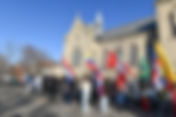
"Faith and unity in celebration: Parishioners gather outside the cathedral, waving flags from various countries, honoring cultural diversity and devotion." (Photo/Vero Gutiérrez). Vero Gutiérrez, Assistant Editor With devotion and respect, the Anglo and Hispanic communities of Saint John the Evangelist Cathedral participated in the celebration in honor of Our Lady of Guadalupe, which concluded with the Eucharistic Celebration marking the end of this year’s Guadalupan festivities on December 14. Although the feast of Our Lady of Guadalupe is traditionally celebrated on December 12, this commemoration—honoring the 494th anniversary of her apparitions on the hill of Tepeyac in Mexico—was integrated into the Sunday Mass to allow participation from both communities. This is the fifth year that a procession in honor of the Virgin of Guadalupe has taken place through the streets of downtown Boise. The mariachi group Cantares de México contributed to the liturgy with Mass hymns, and afterward, the faithful joined a procession through several streets in downtown Boise, concluding with a community celebration at the gym adjacent to the cathedral. The Cantares de México mariachi band performed songs from the Mass during the celebration. Then, the faithful took part in a procession through downtown Boise, concluding with a community celebration in the gym adjacent to the cathedral. The Anglo and Hispanic communities of Saint John the Evangelist Cathedral participated with devotion and respect in the celebration honoring Our Lady of Guadalupe. The celebration culminated with the Eucharistic celebration, closing this year’s Guadalupe festivities on December 14. The procession was led by an image of Our Lady of Guadalupe, placed in a frame and surrounded by flags from various countries, carried on a vehicle. With the cross held high and the acolytes carrying candles, the altar servers led the procession, followed by the priests—Father Germán Osorio, rector of the Cathedral; Father Tim Segert; and Deacon O’Neill Derrick—and the faithful. Various groups of dancers representing indigenous Mexican cultures also participated, along with musical bands, mariachi, and horseback riders. During his homily, Father Germán Osorio emphasized the importance of both communities celebrating this special feast together and recognizing Mary as the Mother of God and Patroness of the Americas. Father Germán connected the theme of Advent with Mary as the central figure in this season of waiting to celebrate the birth of Jesus Christ. The priest recalled the words of the prophet Isaiah, who delivers a powerful message of hope: “ The desert and the parched land will rejoice; the wilderness will blossom and flourish.” “This is the heart of Advent,” Father Osorio affirmed. “God comes precisely where life feels dry, divided, or wounded, and He is preparing a renewal.” The prophet Isaiah speaks of eyes and ears being opened, of the lame leaping, and of the mute singing. He reminded the congregation that this is not just about individual healing, but rather about the restoration of a people, of a community that comes together again on the sacred path that leads to God. Continuing with the theme of the celebration of Our Lady of Guadalupe, Father Osorio noted that, in this season of waiting, we rejoice because God does not remain distant. He draws nearto us. The procession ended with the men on horseback. This message, he said, is reaffirmed in celebrating Our Lady of Guadalupe, who, in 1531, appeared not to a powerful man, but to a humble one, Saint Juan Diego. She spoke his language, shared his culture, and revealed a God who sees, hears, and walks with his people. Through the apparition and message of Our Lady of Guadalupe, the desert of despair blossomed into faith for an entire continent. Today, the vision of Isaiah and the message of Our Lady of Guadalupe are present here among us. Our cathedral parish is blessed to have two great communities, the Anglo and the Hispanic, with different histories, languages, and traditions. However, Advent reminds us that we are one people, walking toward the same God. Our Lady of Guadalupe is among us not as a mother who divides, but as the Mother of God who gathers her children together. Alive with tradition: an Aztec dancer participates in the procession honoring Our Lady of Guadalupe, wearing a majestic feathered headdress and ceremonial attire. She teaches us that unity does not mean uniformity, but rather walking together, listening to one another, and recognizing Christ in every person. When this happens, the desert blossoms; when we remain united in faith, joy overcomes fear, and hope conquers division. As Isaiah says, "Those the Lord has rescued will return… and everlasting joy will be theirs." This joy is not just for one group; it is for all who trust in God. The presence of people wearing traditional indigenous and mestizo clothing is common in Mexican religious and cultural celebrations.