.png)


French Spirituality: Heroic love conquers all

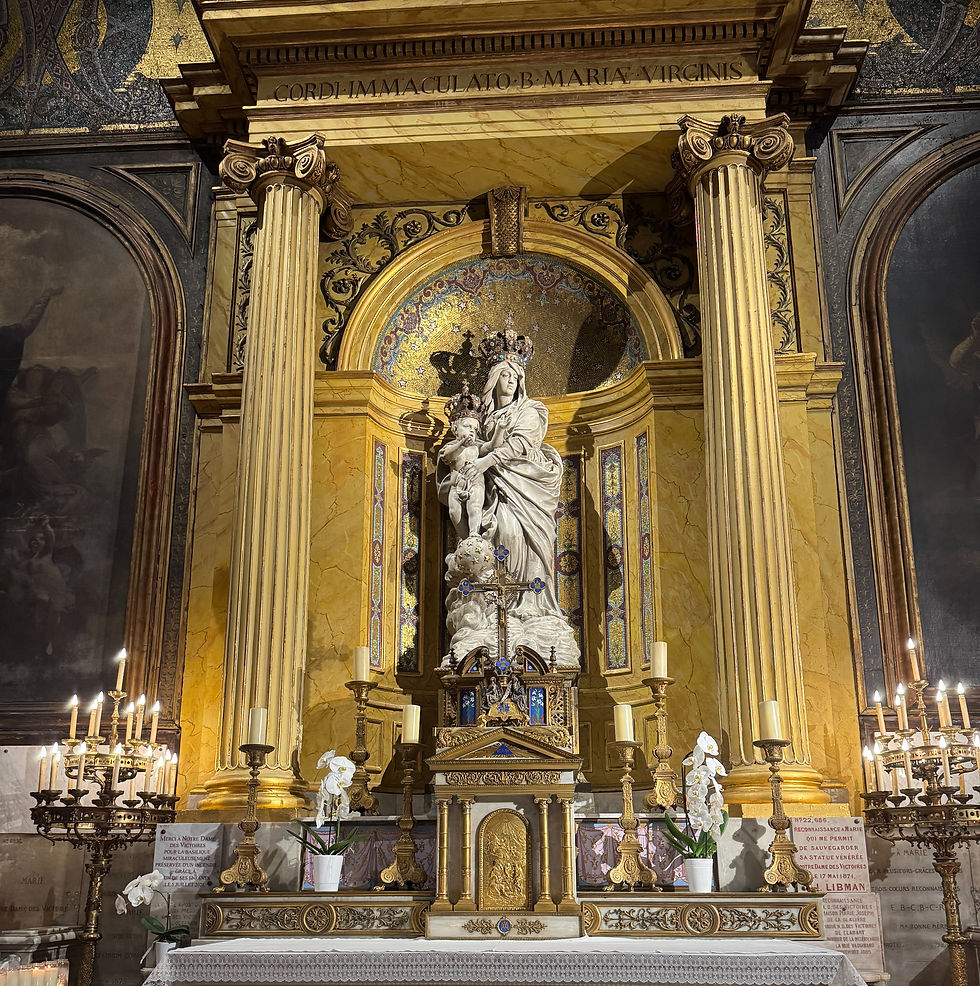
Our Lady of Victories statue bears a crown given by the pope in 1853. (ICR photo/Emily Woodham)
By Emily Woodham
Staff Writer
Editor’s note: Staff writer Emily Woodham continues her series based on her recent trip to France. Her first installation was published in the Oct. 10 issue of the Idaho Catholic Register. You can read the story by clicking on the Catholic News Article’s “More Articles” section at idahocatholicregister.org.
PARIS, France — Many of the churches of France bear scars from the religious persecutions during the French Revolution, from 1789 until 1801, when Napoleon restored the Catholic Church in France.
Statues were defaced or smashed, murals whitewashed and sacramental treasures melted for their gold and silver. The Revolutionary government sanctioned its own state church, but it was not authentic.
During this time, religious communities and priests had to leave in exile or be killed. But throughout France, the faithful resisted with courage and heroic love. Priests traveled at night from town to town to celebrate Masses and hear Confessions in secret. Faithful laity hid them in attics or basements during the day.
After surviving the violent turmoil of the 18th and 19th centuries, the Church was attacked again in 1936, when the government closed convents and seized churches. Then in 1939, the Nazis took the north of France, including Paris, and shut down the Church. During these times of intense suffering, French Catholics persevered. Even today, in churches in Paris, priests encourage their parishioners in homilies to live with courage and heroic love.
“I think heroic love in French spirituality comes from the monastic heritage in France. It is first of all a love that is lived, not just feelings,” said Father Dominique Fauré, prior at the Verbum Spei Monastery of Our Lady of Ephesus in Boise, Idaho. Father Fauré was raised in Paris. It was there that he answered the call to Religious life.
“The main renewal of faith in France has been through Religious life, which is following the call to leave everything and follow Jesus,” Father Fauré continued. “There’s a sense of giving oneself fully to Christ without keeping anything for oneself. This selflessness is the heroic dimension of love. This heroic love, this courage, was also necessary for all the times the French Church had to resist, whether during the Revolution or during World War II.”
Two years ago, Aleteia, a global Catholic news and media website, reported that only 25% of the population of France identifies as practicing Catholics. It’s an underwhelming number in a country that our Blessed Mother, Mary, has historically portrayed as the “eldest daughter of the Church” because it is one of the first nations to officially adopt Christianity.
However, the Diocese of Paris is reporting an increase in vocations to the priesthood, and Religious communities in Paris are also growing.
Currently, the government is supportive of the Church. This has allowed priests to focus more on pastoral and sacramental duties. With churches and Catholic art throughout the city, there is also constant evangelization through beauty.
“Even if so many are no longer practicing the faith, the whole French culture is Catholic,” Father Fauré explained. “A culture is what we transmit from one generation to the next in order to help an individual of the culture mature in goodness. France has deep roots in Catholic values, especially the values of art, beauty and the intellect.”

The Basilica of Our Lady of Victories was desecrated and used as the Stock Exchange under the government of the French Revolution. (ICR photo/Emily Woodham)
The Basilica of Our Lady of Victories in Paris stands out as an example of the resilience of the Church in France, its resistance against oppression, and deep value of beauty.
In 1629, King Louis XIII of France (1610-1643) gave permission and funds to Discalced Augustinians (Les Petits-Pères or “Little Fathers”) to build a convent dedicated to Our Lady of Victories. Devotion to Our Lady of Victory (singular) was declared following the miraculous success of the Catholic military over the Ottoman Empire on October 7, 1571. Louis XIII wanted to expand on Our Lady’s generosity by calling her Our Lady of Victories (plural) in gratitude for her protection and the many victories granted his armies through her intercessions. The ground for the church was dedicated on December 8, the Feast of the Immaculate Conception.
In 1637, one of the Little Fathers, Brother Fiacre, had several visions in one night of the Blessed Mother. She told him that King Louis XIII would at last have a son, after 22 years of his wife being unable to carry a child to term. In thanksgiving for the miracle, Louis XIII publicly consecrated France to the Virgin Mary on Aug. 15, 1638, the Feast of the Assumption. On September 5, the queen gave birth to Louis XIV.
The fame of the visions at Our Lady of Victories and the miraculous birth of the king’s son grew throughout France. The statue of Our Lady of Victories became known as a “Refuge of Sinners.”
In Europe, statues or shrines of the Blessed Mother that were considered a “Refuge of Sinners” were designated as a particular place of merciful answers to prayer, especially for conversions and healing.
During the French Revolution, the original statue of Our Lady of Victories disappeared along with all the other sacramental treasures of the church. The Revolutionary government turned the church building into the Paris Stock Exchange. All religious decorations and murals were whitewashed.
At the end of 1799, Napoleon became the leader of the new French government, marking the end of the Republic’s rule. Under his direction, persecution of the Church ended in 1801. Catholics bargained with the French government for the church building of Our Lady of Victories for seven years. In 1809, the government finally surrendered the building back to the Church and a new statue of Our Lady of Victories was installed.
Like most parishes in France, Our Lady of Victories struggled to recover from the Revolution. Many Catholics in Paris lost their faith during the persecutions. In the first decades of the 19th century, the area of Our Lady of Victories was known more for its banking and businesses than for its faith. But the small group of parishioners who faithfully attended Mass did not give up hope.

The religious and sacramental artwork and vessels were installed after the Basilica of Our Lady of Victories was reconsecrated in 1809. The original artwork was whitewashed (the ceiling still bears the scars of being whitewashed) or destroyed during the French Revolution. (ICR photo/Emily Woodham)
The Medal of the
Immaculate Conception
In July of 1830, about one-and-a-half miles south of Our Lady of Victories, a young Sister of Charity, St. Catherine Labouré, saw a brilliant apparition of the Blessed Virgin Mary. On November 27, the Blessed Mother appeared to St. Catherine again and gave her instructions for the Medal of the Immaculate Conception (later called the Miraculous Medal) emblazoned with the prayer: “O Mary, conceived without sin, pray for us who have recourse to thee.”
The Blessed Mother also instructed that on the back of the medal, the Sacred Heart of Jesus and the Immaculate Heart of Mary were to be inscribed.
This was 24 years before the Immaculate Conception was declared as dogma by Pope Pius IX (1846-1878) and 28 years before Our Lady of Lourdes said, “I am the Immaculate Conception.”
Although there were some controversies and arguments in the Church against the Immaculate Conception, St. Catherine and her spiritual director, in “heroic love,” obeyed the Blessed Mother’s instructions. The medals were first made on June 30, 1832.
At the time, Paris was deep in a cholera pandemic that reached the city in March of that year. The Sisters of Charity distributed the medal, and people were miraculously healed of cholera. Other graces were also reported, especially of conversions. News of the miracles spread, and thousands of people began asking the Sisters for medals. Devotion to the Immaculate Heart of Mary quickly grew.
Consecration to the Immaculate Heart of Mary
In 1836, Father Charles Desgnettes was assigned to Our Lady of Victories. He was a serious priest, who struggled with impatience, but he was also sincere in his faith and concise in his preaching. His stalwart nature helped turn the tide of disbelief and hedonism in a section of Alençon (where St. Thérèse of Lisieux was later born in 1873). He had also served at the chapel of the Paris Missions Society near the Chapel of the Miraculous Medal. Although he had to flee during the brief revolt in 1830, he returned to Paris in 1832 to help during the cholera pandemic.
At his first Mass at Our Lady of Victories, he was completely discouraged. About 40,000 lived in the area of his new parish, but only 40 went to Mass that day. He persevered for four years to bring revival to the area, but nothing worked. On December 3, 1836, he had resolved to resign, certain that it was better to admit failure and to move on to where he could be more fruitful.
As he walked up the steps to the altar to celebrate Mass that day, he heard an interior voice say to him, “Consecrate your parish to the Most Holy and Immaculate Heart of Mary.”
There is no record of him ever meeting St. Catherine Labouré, but given his proximity to the Sisters of Charity, it is certain he knew of the Miraculous Medal and the devotion to the Immaculate Heart of Mary. After Mass, he wrote down prayers and statutes for an association of the faithful, the Brotherhood of Our Lady of Victories, for consecration and dedication to the Immaculate Heart.
On December 10, the archbishop of Paris approved the association. The next day, at the morning Mass, only 10 people were present. Father Desgnettes invited the public to vespers that evening for the first meeting of the Brotherhood. When he entered the church for vespers, more than 500 people were waiting in the pews. Many of them said that they weren’t sure why they were there, but they had simply felt compelled to be present. Father Desgnettes lead everyone in the consecration to the Immaculate Heart.
The parish of Our Lady of Victories quickly grew. In 1838, the pope declared the Brotherhood of Our Lady of Victories the universal Archconfraternity of the Immaculate Heart of Mary for the Conversion of Sinners.
People went to Our Lady of Victories with their desperate needs and found their prayers answered. To the French, she was truly “Mother of Mercy” and “Refuge of Sinners.”
Through the Archconfraternity, associations of prayer and consecration to the Immaculate Heart of Mary spread worldwide. A year before the declaration of the dogma of the Immaculate Conception, Pope Pius IX sent a crown and ordered that it be placed on the head of Our Lady of Victories.

This side altar commemorates the day St. Thérèse of Lisieux visited the basilica with her father, St. Louis Martin, to give thanks for her miraculous healing. (ICR photo/Emily Woodham)
One of the most famous miracles attributed to Our Lady of Victories is the healing of St. Thérèse of Lisieux. Thérèse became seriously ill in the spring of 1883, when she was 10. Her father asked for a novena of Masses at the Basilica of Our Lady of Victories, from May 5 to the 13th, which was Pentecost Sunday that year.
On the last day of the Masses, Thérèse was healed. Four years later, just six months before she entered the Carmelites, she went to Paris to see Our Lady of Victories and give thanks. Thérèse later wrote: “A miracle was needed and Our Lady of Victories provided it.”
Today, the basilica is still a treasured Marian shrine and is in the care of the Benedictine Sisters of Sacre Coeur of Montmartre. The Feast of Our Lady of Victories is December 3.

Comments